Mark × species · Primary target
Bass at Brittas Bay (South End).
Bass is a primary target at Brittas Bay (South End) near Brittas Bay. Best window on this ground: April to November (peak autumn Sep to Nov; specimen window during E gales). Take the R750 south from Wicklow town, turn east at the Brittas Bay signs.

Quick facts
- Mark type
- Beach
- Skill
- Intermediate
- Catalogue rank
- Primary target
Why fish Bass at Brittas Bay (South End)
Premier Wicklow bass beach. Specimen bass in storm conditions; smoothhound and rays in summer.
One of the finest beach fishing marks in Leinster.
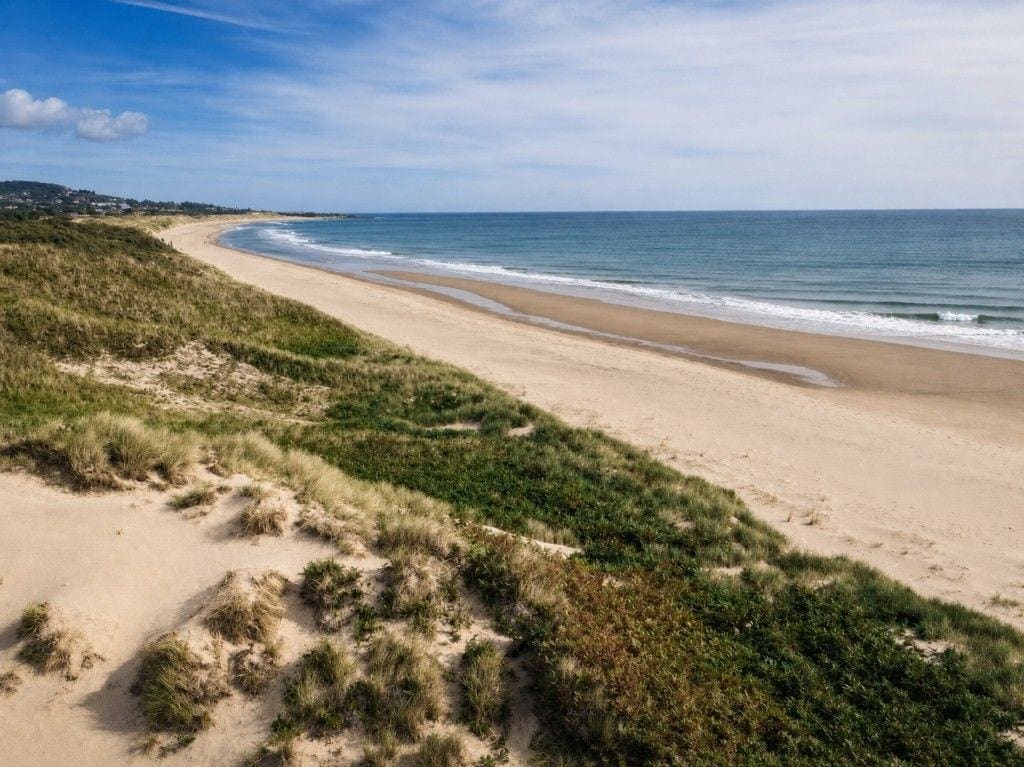
Brittas Bay offers a long, sandy beach with parallel gully and sandbar systems that hold bass, smoothhound and rays in summer.
The southern end, away from the main car park, is the most productive ground, cleaner sand, fewer crowds.
The beach has produced specimen bass over 10 lb in coloured rough water during easterly gales, the documented persistence-rewarded condition.
Surf beaches, rocky headlands, harbour walls, estuaries and sandy gutters, most reliably in coloured, wind-driven surf and around tidal rips or white water.
Local note: Bass here follow the weather before the clock: after a south-easterly blow the beach fishes exceptionally for two to three days while the water holds colour, and the documented specimen fish over 10 lb came in exactly those conditions. Once it clears, summer sessions need close to 100m to reach the gullies.
Premier beach mark. Specimen bass in autumn storms.
Premier Wicklow bass beach, smoothhound on summer crab baits, respect surf and undertow on big days.
Hardback green shore crab is the documented top smoothhound bait, modern UK/Irish consensus (Tronixpro, Talk Sea Fishing) is that peeler is attacked too quickly by lesser species like dogfish and pouting, while hardback lasts and selects properly for hounds.
Bait size discipline is critical: 2.5×1 inch sausage shape, bigger baits get picked up and dropped, which is the most common cause of dropped takes here.
The conditions tourists avoid (easterly gales with driving rain) are the conditions that produce specimen bass over 10 lb.
Season and tide
At Brittas Bay (South End), Bass is worth targeting in April to November (peak autumn Sep to Nov; specimen window during E gales). Coast-wide, Bass runs April to November (peaks September to November autumn peak on Wicklow beaches).
Wider mark season: Bass: April to November (peak autumn Sep to Nov; specimen window during E gales), Smoothhound: May to October (numbers build from late May spring tides), Thornback ray: May to October, Codling: October to February, Whiting: October to February, Flounder: October to March, Dab: October to February
Tide guidance here: Flooding tide is the productive window for hounds and rays through the gullies, particularly two hours before high water until the tide peaks. After a south-easterly blow the bass fishing can be exceptional for 2 to 3 days. Documented summer requirement: ~100m casts; after storm conditions, short casts adequate.
First two hours of the flooding tide in surf conditions. Dawn and dusk are most productive, bright midday sun switches them off. After a good easterly blow, any stage of tide can produce fish close in.
Fishable phases: first-flood, mid-flood, high, first-ebb. Peak: mid-flood, high.
Tactics on this mark
Target the first two hours of flood on surf beaches, casting short into coloured water with crab baits or soft plastics; in calm clear conditions, switch to lures around rock edges and harbour walls at dawn and dusk.
Pulley rig clipped down with 4/0 hook (smoothhound); Running ledger; Surface lures and weedless soft plastics (bass)
Gear: open beach. Facing ESE.
- Running ledger, 15 to 20 lb fluorocarbon hooklink, size 2/0 to 4/0 circle hook
- Pulley rig in heavy surf
- Soft plastics, paddle tails and shads on 10 to 20g jig heads
- Surface lures at dawn and dusk in calm conditions
- Pulley rig clipped down with 4/0 hook (smoothhound)
- Running ledger
- Surface lures and weedless soft plastics (bass)
Baits and lures
Bass baits and lures: Peeler crab (spring and autumn); Sandeel; Ragworm; Soft plastic lures; Surface poppers and walkers.
What this mark typically holds: Hardback green shore crab (the documented top hound bait, outlasts peeler against lesser species); Peeler crab (when bites are quick); Whole sandeel; Ragworm/squid cocktail (rays); Bait sized 2.5×1 inch sausage shape for hounds.
Hardback green shore crab (the documented top hound bait, outlasts peeler against lesser species); Peeler crab (when bites are quick); Whole sandeel; Ragworm/squid cocktail (rays); Bait sized 2.5×1 inch sausage shape for hounds
Access and ground
Take the R750 south from Wicklow town, turn east at the Brittas Bay signs. Pennycomequick Bridge over the Redcross River is the landmark on the way in. Walk south along the beach from the main car park, the further you walk, the better the fishing.
Parking: Paid parking is available at the beach. Brittas Bay is a popular destination especially in summer so arrive early to secure a space. The car park can fill quickly on fine weekends and bank holidays.
Safety: Strong longshore drift in heavy surf, be aware of your position and do not wade. Deep gullies can fill quickly on a flooding tide; mark your route back. Very busy with bathers in summer, fish the shoulders of the day (dawn and dusk).
Nearest tackle: Wicklow town (approximately 15km north) has the nearest tackle shops. Stock up before heading to Brittas Bay as there are no tackle supplies locally.
Nearest town: Brittas Bay. Skill level: Intermediate.
Size and identification
Typical shore size: 1 to 3 kg from the shore on Wicklow beaches. Specimen class: Irish specimen weight is 4.5 kg; a bass over that is a fish of the season, not a routine surf capture.
Silver flanks with a blue-grey back and white belly. Two dorsal fins, the first with sharp spines. Mouth large and slightly upturned. Young bass show faint lateral spots. Unmistakable once you've seen one.
Tip: Bass feed into the wind and surf, don't be put off by rough conditions. A short cast (30 to 50m) into coloured water consistently outperforms distance casting into the clean water beyond the surf. In calm clear conditions switch to lures and work the edges of kelp and rock.
Irish shore context: record class around 8.08 kg (17 lb 13 oz), Doughmore Strand, 2000.
Same-mark companions
Other targets on the same mark include Smoothhound, Thornback ray, Codling, Whiting, Dogfish, Flounder. Open those pair pages or the full mark guide when you want a multi-species session.
Live advice for Brittas Bay (South End) updates on the daily plan. Pair this page with the Bass species guide for coast-wide season bars and conservation detail.
Conservation
Bye-Law No. 826 of 2007 applies: two bass per angler per 24 hours, none under 42 cm, when retention is permitted, catch-and-release only 1 Feb to 31 Mar (Irish Sea / EU ICES 7a), no bass angling 15 May to 15 June. Most serious anglers practice full catch and release.
Guide conservation label: Bag Limit Applies.
Confirm current bag limits and closures on the Bass species guide and /learn/rules before retaining fish.
Other species at Brittas Bay (South End)
Next steps
Related article: Bass Fishing Wicklow: Best Marks, Baits and Tides
Live session advice for this mark sits on Today's plan. Rules and bag limits: learn / rules.
NEXT STEP
Open the full mark or species guide.
Pair pages assemble mark and species catalogue facts for this ground. Depth sessions live on today's plan.